Jim is the founder and owner of Pulse Combustion Systems. He established company headquarters in Payson, Arizona, and managed the development of the company’s pulse combustor and its intellectual property while growing the company organically. His current project is augmenting the company’s combustor technology with two new heat/atomization sources – a low-NOx duct burner, or an indirect gas-fired heater, which ensures zero nitrates in the pulse-dried powder. These new heat sources also give the company the capability to handle pharmaceutical products.
Dryer yield in industrial spray drying is fundamentally driven by the mechanical stability of the atomization process. While formulation is a baseline requirement for success, nozzle clogging is a significant cause of product loss during production.
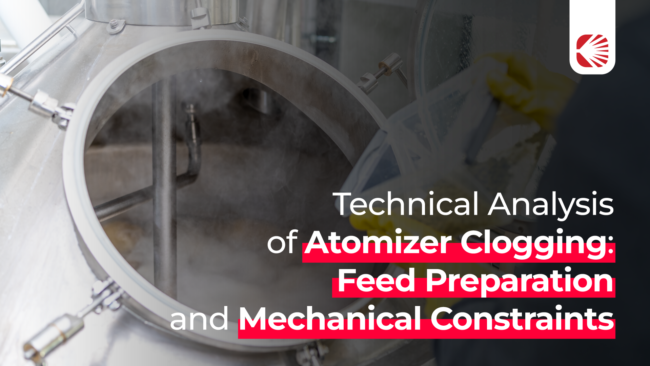
In industrial spray drying, atomizer clogging is a primary driver of unscheduled downtime and process instability. Technical data indicates that for traditional pressure nozzle systems, clogging is most frequently the result of specific feed preparation errors.
In industrial spray drying, atomizer clogging is a primary driver of unscheduled downtime and process instability. Technical data indicates that for traditional pressure nozzle systems, clogging is most frequently the result of specific feed preparation errors.
In industrial spray drying, the processing of abrasive or corrosive feed materials presents a fundamental challenge to the longevity and performance of traditional rotary and nozzle atomization hardware. Every conventional system, whether utilizing a high-speed rotary disc or a pressure nozzle, begins its operational cycle with new components, including the atomizer head and the feed pump. However, the physics of high-pressure delivery ensures that these components begin to degrade immediately upon contact with aggressive feedstocks.
Conventional spray drying of abrasive or corrosive materials typically relies on high-pressure pumps—often reaching 5,000 psi—and restricted spray nozzles. These mechanical components are prone to rapid erosion and chemical degradation, leading to frequent maintenance cycles and inconsistent spray patterns. For process engineers, Pulse Atomization Spray Drying (PASD) provides an alternative mechanism that eliminates the fundamental dependence on high fluid pressure and restricted orifices.
In the processing of abrasive or corrosive slurries, facilities often face a recurring cycle of nozzle erosion and pump failure. When components degrade rapidly, the standard engineering response is to specify harder materials, such as tungsten carbide or advanced ceramics, or to install pumps designed for higher wear resistance. However, technical data suggests that the root cause of these failures is often not the material of the components themselves, but rather a fundamental dependence on high-pressure atomization.
In industrial spray drying, the processing of abrasive slurries often creates a significant operational bottleneck. For facilities utilizing traditional spray drying technology, frequent maintenance shutdowns are often accepted as an unavoidable cost of doing business. However, a technical evaluation of the underlying mechanics suggests that these disruptions are not a result of the material itself, but rather a consequence of the atomization method employed.
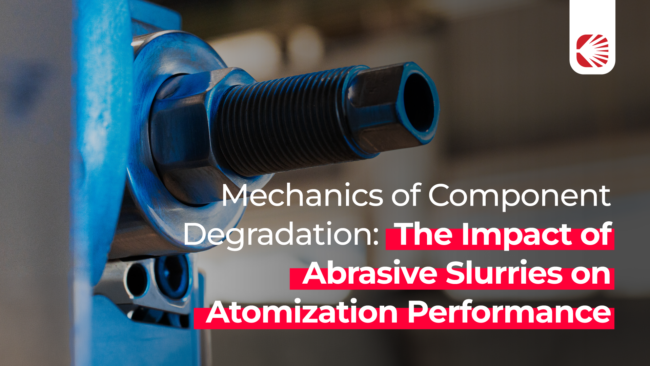
Mechanical nozzle erosion is a progressive failure mode in conventional spray drying systems that utilize high-pressure atomization. As abrasive or corrosive feed materials pass through a precision-machined nozzle orifice, the opening gradually enlarges beyond its intended diameter. In traditional systems, which often operate at pressures reaching 5,000 psi, the high-pressure pump must compensate for this wear by working harder to maintain the target process pressure.
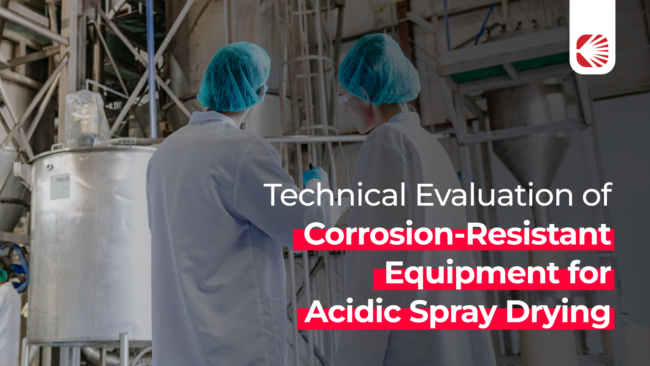
In industrial spray drying, managing corrosive chemicals and acidic formulations requires addressing two primary mechanical failure points: the atomizer nozzle and the feed pump. Traditional systems often utilize specialty alloy nozzles designed for corrosion resistance. However, these components are frequently expensive and may only delay, rather than eliminate, the degradation caused by 24/7 exposure to aggressive materials.
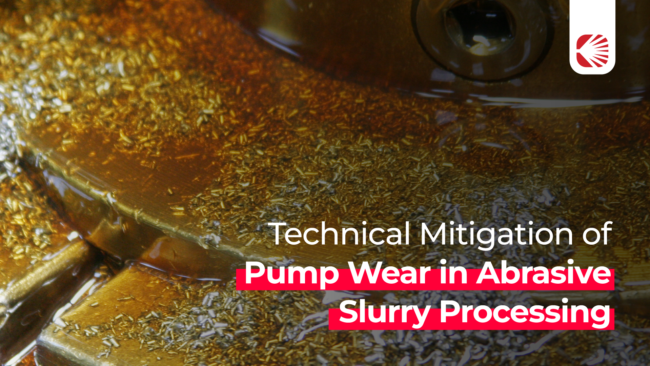
For process engineers handling minerals or ceramic slurries, pump and nozzle wear represent significant operational hurdles that often defy traditional correction. In conventional spray drying, the physics of the process require high-pressure pumps to force abrasive material through a restricted nozzle orifice, typically at pressures up to 5,000 psi. This high-velocity contact between abrasive particles and mechanical components makes erosion a physical inevitability.